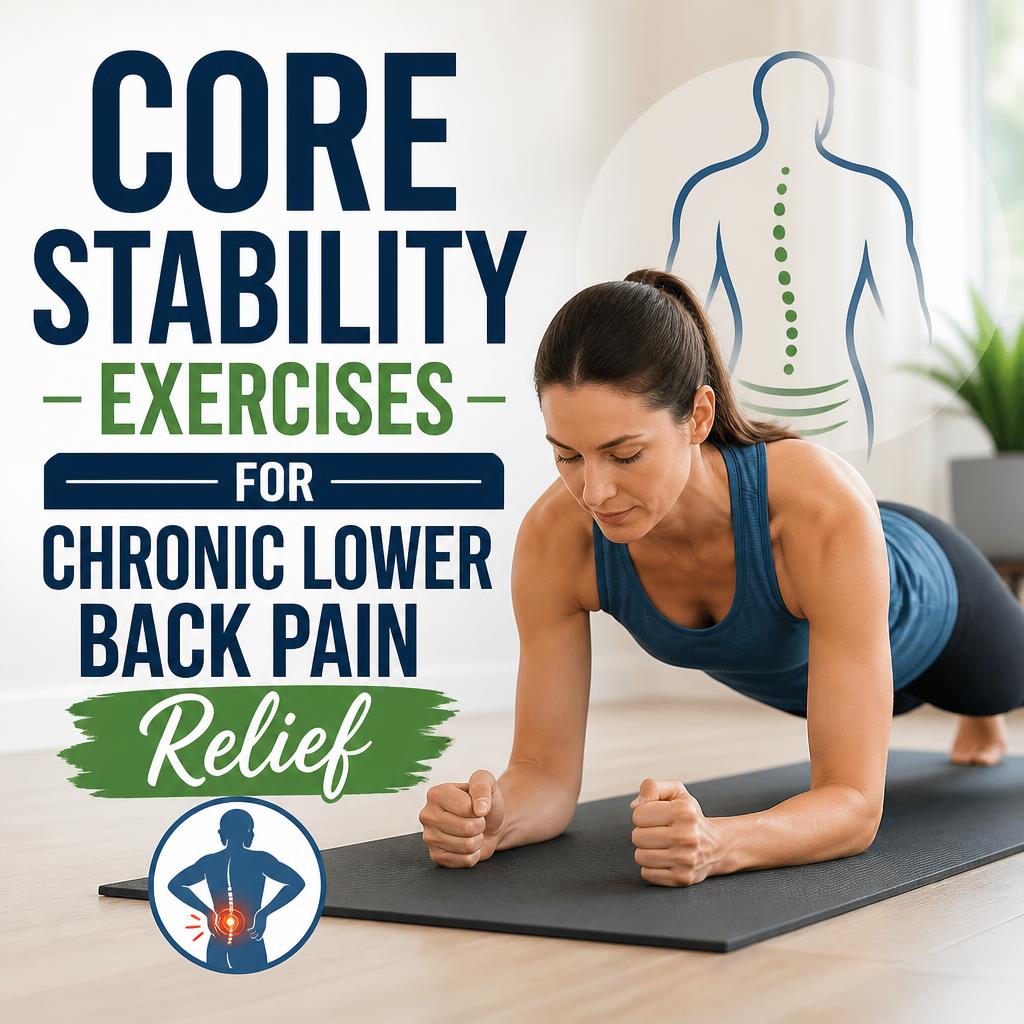
Chronic lower back pain (LBP) affects millions of people worldwide, often creating a frustrating cycle where fear of movement leads to weakness, which in turn causes more pain. While rest may seem intuitive, research consistently shows that targeted movement is one of the most effective long-term solutions. Specifically, core stability exercises for chronic lower back pain relief have been proven superior to general exercise for reducing pain intensity and improving functional disability.
Unlike traditional ab workouts that focus on visible “six-pack” muscles through repetitive spinal flexion (like crunches), true core stability exercises for chronic lower back pain relief target the deep stabilizing system. These muscles act as an internal corset, protecting your spine during daily movements. This guide breaks down five foundational, spine-sparing core stability exercises for chronic lower back pain relief backed by biomechanical research to help you build resilience safely.
Why Core Stability Exercises for Chronic Lower Back Pain Relief Work Better Than Ab Strength
Understanding the difference between strength and stability is critical when selecting core stability exercises for chronic lower back pain relief. Traditional abdominal exercises like sit-ups generate high compressive loads on the lumbar spine, which can exacerbate disc-related pain. In contrast, core stability exercises for chronic lower back pain relief focus on anti-movement: teaching your torso to resist unwanted motion while your limbs move.
Research published in the Journal of Orthopaedic & Sports Physical Therapy highlights that patients with chronic LBP often exhibit delayed activation of the transverse abdominis (TrA) and multifidus muscles—the primary targets of effective core stability exercises for chronic lower back pain relief. These deep stabilizers fire milliseconds before limb movement in healthy individuals, but this timing is disrupted in those with back pain. Retraining this neuromuscular control—not just building muscle size—is the primary goal of the core stability exercises for chronic lower back pain relief outlined below.
The 5 Best Core Stability Exercises for Chronic Lower Back Pain Relief
These core stability exercises for chronic lower back pain relief are adapted from the renowned McGill Big 3 protocol, developed by Dr. Stuart McGill, a leading spine biomechanist. They are designed to maximize muscle activation while minimizing spinal load, making them ideal core stability exercises for chronic lower back pain relief (11).
1. The Modified Curl-Up
This is one of the safest core stability exercises for chronic lower back pain relief because it activates the rectus abdominis without flattening the natural lumbar curve.
- How to do it: Lie on your back with one knee bent and the other leg straight. Place both hands under your lower back to preserve its natural arch. Lift only your head, neck, and shoulders about 1 inch off the floor. Hold for 10 seconds while breathing normally.
- Reps: 3 sets of 3–4 holds (10 seconds each).
- ✅ Form Cue: Imagine balancing a glass of water on your chin; don’t tuck your chin or crane your neck.
- ❌ Common Mistake: Lifting too high or pressing your lower back into your hands.
- 🖼️ Image Alt Text Suggestion: Woman performing modified curl-up as part of core stability exercises for chronic lower back pain relief on yoga mat
2. Side Plank (Knee or Full)
The side plank is among the most effective core stability exercises for chronic lower back pain relief (13) for targeting the quadratus lumborum and obliques with minimal shear force.
- How to do it: Lie on your side with knees bent at 90° (modified) or legs straight (full). Prop yourself up on your elbow directly under your shoulder. Lift your hips until your body forms a straight line from head to knees/feet. Hold.
- Reps: 3 sets of 10–30 second holds per side.
- ✅ Form Cue: Keep your rib cage stacked directly over your pelvis; don’t let your hips drift backward.
- ❌ Common Mistake: Holding your breath or letting the top shoulder roll forward.
3. Bird-Dog
This exercise trains cross-body coordination and multifidus activation, two key components of core stability exercises for chronic lower back pain relief (14).
- How to do it: Start on all fours with hands under shoulders and knees under hips. Simultaneously extend your opposite arm and leg until parallel to the floor. Hold for 10 seconds, then return to start. Alternate sides.
- Reps: 3 sets of 3–4 reps per side (10-second holds).
- ✅ Form Cue: Imagine balancing a tray of drinks on your lower back; keep it perfectly level.
- ❌ Common Mistake: Arching the lower back to lift the leg higher. Range of motion matters less than spinal neutrality.
4. Dead Bug (Supine Core Bracing)
The dead bug teaches you to maintain core tension while moving extremities—a direct transfer skill developed through core stability exercises for chronic lower back pain relief.
- How to do it: Lie on your back with arms extended toward the ceiling and knees bent at 90°. Press your lower back gently into the floor. Slowly lower one heel to tap the floor while keeping the opposite arm overhead. Return to start and alternate.
- Reps: 3 sets of 8–10 taps per side.
- ✅ Form Cue: Exhale forcefully as you lower your leg to engage the deep core.
- ❌ Common Mistake: Letting the lower back peel off the floor. Reduce range of motion if this happens.
5. Pallof Press
This anti-rotation movement rounds out a complete routine of core stability exercises for chronic lower back pain relief (16) by addressing rotational stability.
- How to do it: Stand perpendicular to a cable machine or resistance band anchored at chest height. Hold the handle with both hands at your sternum. Press straight out, resisting the band’s pull to rotate your torso. Hold 3–5 seconds, then return.
- Reps: 3 sets of 8–10 presses per side.
- ✅ Form Cue: Keep feet shoulder-width apart and knees slightly bent for a stable base.
- ❌ Common Mistake: Allowing the torso to twist toward the anchor point during the press.
Programming Guidelines for Core Stability Exercises for Chronic Lower Back Pain Relief
Consistency trumps intensity when performing core stability exercises for chronic lower back pain relief. Follow these evidence-based programming principles:
| Parameter | Recommendation for Core Stability Exercises for Chronic Lower Back Pain Relief | Rationale |
|---|---|---|
| Frequency | 3–4x per week | Stabilizer muscles recover quickly and respond to frequent neural practice |
| Hold Duration | 10-second intervals | Builds endurance without fatigue-induced form breakdown |
| Progression | Increase hold time → add reps → increase leverage difficulty | Ensures mastery before adding complexity |
| Pain Threshold | ≤3/10 acceptable; >3/10 stop | Some discomfort is normal; sharp or radiating pain is not |
| Timeline | 6–12 weeks for noticeable change | Neuromuscular adaptation precedes hypertrophy |
💡 Pro Tip: Pair these core stability exercises for chronic lower back pain relief with diaphragmatic breathing. Proper breathing mechanics reduce intra-abdominal pressure dysregulation, which is common in chronic LBP patients. Practice 5 minutes of box breathing before your session to prime your nervous system.
Read for more Blogs: Gujarat Titans vs Rajasthan Royals Match Preview, Venue Details, Playing Analysis & Full Match Information
When to See a Professional About Core Stability Exercises for Chronic Lower Back Pain Relief
While these core stability exercises for chronic lower back pain relief are safe for most, certain red flags require immediate medical evaluation:
- Pain radiating below the knee (sciatica)
- Numbness, tingling, or weakness in the legs
- Bowel or bladder dysfunction (emergency)
- Pain that worsens despite 4+ weeks of consistent core stability exercises for chronic lower back pain relief (20)
- Unexplained weight loss or night pain
A physical therapist can perform a differential diagnosis and tailor these core stability exercises for chronic lower back pain relief to your specific pathology.
Final Thoughts on Core Stability Exercises for Chronic Lower Back Pain Relief
Building resilience through core stability exercises for chronic lower back pain relief is a marathon, not a sprint. The goal isn’t to feel a burning sensation—it’s to develop subconscious control that protects your spine during every movement of daily life. Start conservatively with these core stability exercises for chronic lower back pain relief, prioritize perfect form over duration, and trust the process. Your spine will thank you.
Frequently Asked Questions About Core Stability Exercises for Chronic Lower Back Pain Relief
Q1. How long does it take for core stability exercises for chronic lower back pain relief to work?
Most studies show significant improvements from core stability exercises for chronic lower back pain relief within 6–12 weeks. However, some individuals report reduced pain within 2–3 weeks as neuromuscular control improves.
Q2. Are planks considered safe core stability exercises for chronic lower back pain relief?
Standard front planks can be problematic if your core fatigues and your hips sag. The modified curl-up and side plank are safer starting core stability exercises for chronic lower back pain relief. Progress to full planks only after mastering shorter-leverage variations pain-free.
Q3. Can I do core stability exercises for chronic lower back pain relief every day?
Yes. Unlike heavy strength training, low-load core stability exercises for chronic lower back pain relief can be performed daily because they primarily train motor patterns rather than causing significant muscle damage. Listen to your body and adjust volume based on soreness.
Q4. Should I avoid all ab exercises and only do core stability exercises for chronic lower back pain relief?
Not necessarily. Avoid exercises involving repetitive spinal flexion under load. Focus instead on the anti-extension, anti-rotation, and anti-lateral flexion core stability exercises for chronic lower back pain relief outlined in this guide.